
Plants
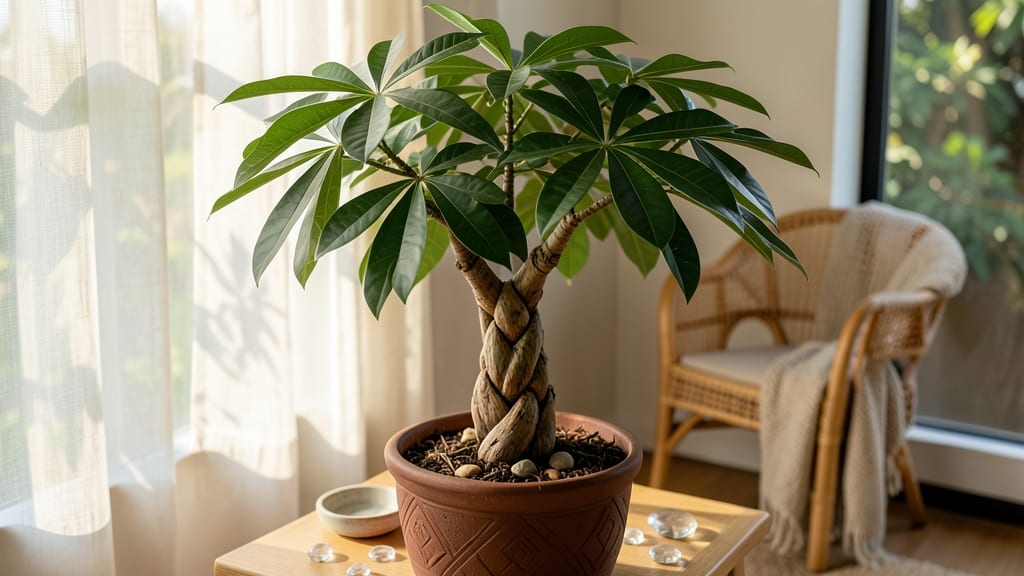
Money Tree plants grow between 3 and 10 feet tall indoors, depending on care and variety, with most reaching 5-7 feet after years of steady growth.
Picture this: your Money Tree 🌿 starts as a modest 1-foot sapling, but without pruning or pot limits, it could soon become a ceiling-high statement piece.
The key to controlling its height lies in light exposure, pruning timing, and pot size—all factors you can adjust right now to keep it at your desired height.
Indoor Money Trees thrive in bright, indirect light but can stretch unnaturally tall if starved for sunlight. A smaller pot also slows growth, while regular pruning encourages bushier, more manageable shapes. The misconception that dwarf varieties exist? Most "small" Money Trees are simply pruned consistently, not a separate species.
Below, I’ll break down how to train your Money Tree to stay compact, the 3 biggest mistakes that make them grow too fast, and when to expect that first 6-foot leap—or how to prevent it entirely.


Money tree height guide: indoor growth limits and realistic expectations
If you're asking how tall do money tree plants grow indoors, the answer depends more on your care routine than genetics. Most Pachira aquatica plants reach 3-6 feet indoors with proper conditions, though some varieties can stretch toward 10 feet if left unchecked.
The key lies in understanding how light exposure, pruning habits, and pot size interact to shape your plant's growth trajectory.
Many new owners assume money trees grow like bonsai by nature, but this tropical shrub actually thrives when given room to stretch—unless you actively manage its height. Without intervention, a money tree can become a ceiling-height statement piece within 3-5 years, which may not suit every home.
Let's break down what influences these growth patterns and how you can steer your plant toward your ideal size.
| Growth Factor | Indoor Height Range | Control Tips |
|---|---|---|
| Standard Variety | 6-10 feet | Prune annually in spring |
| Dwarf Variety | 3-5 feet | Use 8" pots max, trim tips |
| Low Light Conditions | 2-4 feet | Rotate pot monthly for even growth |
| Optimal Light | 5-8 feet | Provide east/west window light |
| First Year Growth | 1-2 feet | Repot in spring if roots bind |
The light conditions in your home play the biggest role in determining your money tree's height. These plants originate from tropical rainforests where they grow tall under dappled sunlight.
Indoors, placing your money tree near an east or west-facing window mimics this natural light pattern, encouraging vertical growth while maintaining healthy foliage.
If you notice your plant growing leggy and sparse, it's likely reaching for more light—either move it closer to a window or supplement with a grow light for 6-8 hours daily.
Contrary to popular belief, there's no such thing as a true "dwarf money tree" variety. What you'll find labeled as "dwarf" are simply young plants or those grown in smaller pots with regular pruning.
The Pachira aquatica species itself has the genetic potential to reach 10-15 feet outdoors, but indoors, its growth is naturally constrained by ceiling heights and limited space.
To maintain a compact shape, focus on pruning the top growth and keeping the plant in a pot that's only slightly larger than its root ball.
Pot size directly correlates with your money tree's height potential. When you repot your money tree, choose a container that's 2-3 inches larger in diameter than the current root system. Using a too-large pot encourages rapid vertical growth as the plant tries to fill the extra space.
For height control, opt for shallow, wide pots that promote bushier growth. I've found that 8-10 inch pots work well for maintaining plants under 5 feet, while 12 inch pots may push your money tree toward its 6-8 foot potential within 3 years.
Pruning isn't just about aesthetics—it's a growth management tool that can keep your money tree at your desired height. The best time to prune is during spring's active growth phase, when the plant can quickly recover and fill out.
To control height, focus on pinching back the top 2-4 inches of new growth. This encourages lateral branching while slowing vertical elongation. For more dramatic height reduction, you can prune back 1/3 of the plant's height, though this will require more frequent maintenance to maintain the shape you want.
Many gardeners mistakenly believe that overwatering will make their money tree grow faster or taller. In reality, consistent moisture is more important than excess water. Allow the top 1-2 inches of soil to dry out between waterings to prevent root rot, which can stunt growth.
I've seen money trees grow 2 feet taller in a single season when given proper water and light, but only when all other conditions are optimal. The key is balanced care—neither neglect nor overindulgence.
If you're working with limited ceiling space, consider air-layering to create a new, smaller money tree from your existing plant. This propagation technique allows you to control the height of your new plant while keeping the original.
Simply wrap a section of stem with moist sphagnum moss and plastic wrap, then wait for roots to form before separating. This method lets you maintain multiple plants at your preferred height without sacrificing the original plant's growth potential.
Remember that your money tree's height isn't set in stone—it's a dynamic process you can influence at every stage. Start with the right pot size, provide optimal light conditions, and establish a regular pruning schedule to guide your plant's growth.
With these techniques, you can enjoy a money tree that perfectly fits your space, whether you prefer a desk-sized companion or a floor-filling statement piece
Outdoor money tree growth: tropical climates vs. temperate zones
Taking your money tree (Pachira aquatica) outdoors can turn it from a modest houseplant into a towering tropical giant—if you're in the right climate.
In tropical zones (USDA 10-12), these plants can reach up to 50 feet tall when planted in-ground, while temperate climates limit growth to 10-15 feet in containers. The difference comes down to year-round warmth, humidity, and soil conditions that supercharge their natural growth.
Your location determines whether your money tree becomes a shade-loving small tree or stays a manageable container plant. In temperate zones (USDA 9-10), outdoor planting requires careful seasonal management—bringing pots indoors before first frost prevents winter damage. Meanwhile, tropical gardeners enjoy continuous vertical growth without seasonal setbacks.
🌿
Container planting dramatically affects height—even in tropical climates. Root-bound money trees in 5-gallon pots max out at 8-10 feet, while in-ground specimens spread their roots freely, triggering rapid vertical growth.
The key difference? Soil volume and root expansion—outdoor money trees develop deep taproots that anchor them for decades of upward growth.
Seasonal growth cycles also shift dramatically. In temperate zones, money trees enter dormancy in winter, halting growth until spring. Tropical money trees, however, grow year-round, with spring and summer producing 6-12 inches of new growth per month under ideal conditions.
This explains why outdoor specimens in Florida or Hawaii can double in height within just two growing seasons.
To control outdoor growth, prune aggressively in late winter before new shoots emerge. Removing 1/3 of the canopy encourages bushier growth and prevents uncontrolled height spikes. In temperate zones, this timing also helps harden off the plant for summer outdoor exposure.
For tropical gardeners, regular structural pruning maintains shape while allowing controlled vertical expansion.
Protect young outdoor money trees from wind damage—their leathery leaves can tear in strong breezes. Stake newly planted specimens until their root systems stabilize (typically 3-6 months).
In cooler temperate zones, use mulch to insulate roots during mild winters, extending the outdoor growing season by 2-4 weeks each side.