
Pruning
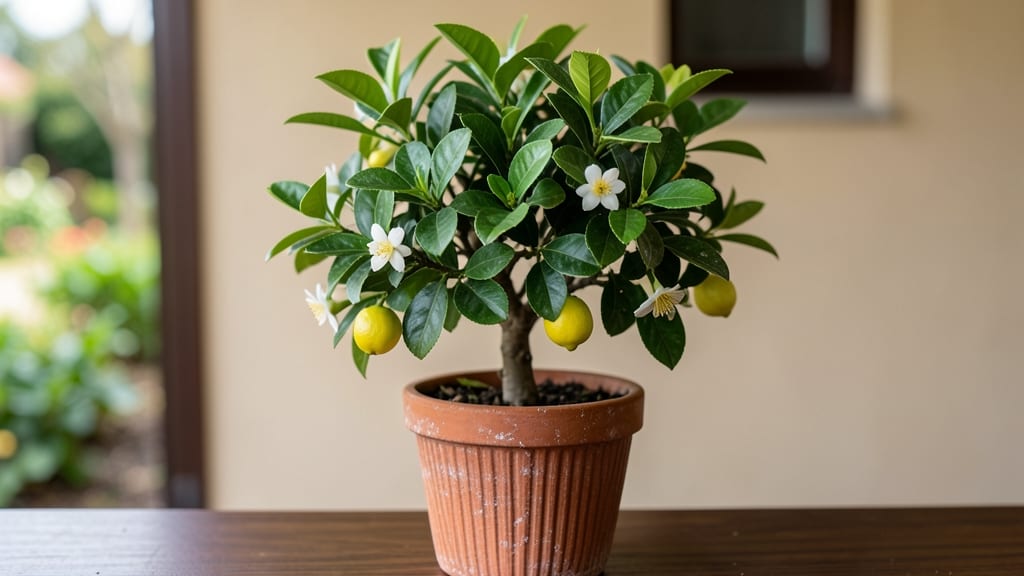
To grow a miniature lemon tree indoors, provide bright indirect sunlight for 6-8 hours daily, use a well-draining potting mix, and maintain consistent moisture without overwatering. Regular pruning keeps the tree compact and encourages fruit production, ideal for dwarf varieties like ‘Meyer’ lemon trees in 4-6 inch pots.
Miniature lemon trees thrive indoors when you mimic their natural Mediterranean environment. 🌿 The key is balancing light exposure—too little causes leggy growth, while direct sun can scorch delicate leaves. I’ve found that east-facing windows offer the perfect balance, especially when paired with occasional rotation to ensure even growth.
Temperature matters too: keep your tree between 65-75°F during the day, with slightly cooler nights to encourage blooming. For winter, reduce watering and move it away from drafts, as these citrus trees naturally enter a dormant phase.
When it comes to pruning, timing is everything. Spring or early summer is prime time—this is when your tree is actively growing and can handle the stress of trimming. Focus on removing any leggy branches or overcrowded growth near the center to improve airflow.
For container size, never go smaller than a 4-inch pot for young trees, and upgrade to 6-inch pots as they mature. The right container with drainage holes prevents root rot, which is the #1 killer of indoor citrus trees.
💡 In This Article
- Optimal Light and Temperature for Indoor Lemon Trees
- Pruning and Container Selection for Compact Lemon Trees
Optimal light and temperature for indoor lemon trees
Lemon trees thrive under bright, indirect sunlight because their natural habitat receives intense Mediterranean light. In indoor settings, place your tree within 3 feet of a south- or west-facing window where it can bask in 6-8 hours of filtered light daily.
Direct sunlight through glass can create hot spots that scorch leaves, causing crispy brown edges.
For homes with limited natural light, supplement with LED grow lights (12-16 hours/day at 3,000-5,000 Kelvin) positioned 6-12 inches above the plant. 🌞 The ideal light intensity mimics early morning or late afternoon sun—think of it as "golden hour" conditions for your tree.
Temperature fluctuations trigger critical growth stages. During active growth (spring-fall), maintain 65-75°F daytime temperatures with 10°F cooler nights to stimulate flowering. Use a thermometer near the plant to monitor—consistent warmth above 80°F stresses the tree, causing leaf drop, while below 55°F halts growth.
In winter, reduce watering as the tree enters dormancy (a natural survival mechanism) and avoid placing it near drafty windows or heating vents, which can cause bud blast (premature flower drop).
Light deficiency shows up in telltale ways: leaves yellow between veins (chlorosis) or stretch excessively (etiolation) as the tree reaches for light. Rotate your tree quarter-turn weekly to prevent lopsided growth, and watch for new growth patterns—healthy leaves should be glossy, dark green, and 2-3 inches long.
For flowering and fruiting, 12+ hours of light becomes essential, which is why grow lights become indispensable in northern climates or during winter months. 💡 The energy from light converts to sugars through photosynthesis, fueling both leaf and fruit production.
Seasonal adjustments are key to long-term success. In late winter, increase humidity (aim for 40-50%) by grouping plants together or using a pebble tray with water—this mimics the Mediterranean's springtime moisture.
For temperature-sensitive varieties like 'Meyer' lemons, avoid sudden changes; move the tree gradually between indoor and outdoor spaces if acclimating to summer breezes. The goal is to create a stable microclimate where the tree can focus its energy on growth rather than stress responses. 🌿
Advanced growers often experiment with red-blue spectrum LED lights (660nm and 450nm wavelengths) to boost flowering, as these mimic the light ratios that trigger citrus blooms. Place lights on a timer for consistency—unlike natural sunlight, artificial light doesn't vary, so your tree relies on this predictable cycle.
For temperature control, consider a small space heater with a thermostat set to 70°F during winter nights to prevent chilling damage.
What most people overlook is the light quality—not just quantity. Citrus trees need blue light (400-500nm) for compact growth and red light (600-700nm) for flowering.
A simple DIY solution is to place a white fluorescent bulb (cool tone) 12 inches away for 8 hours, then switch to a warm LED bulb for the remaining 16 hours to simulate day-night cycles. This mimics the natural photoperiod that triggers citrus trees' reproductive cycle. 🌱