
How To
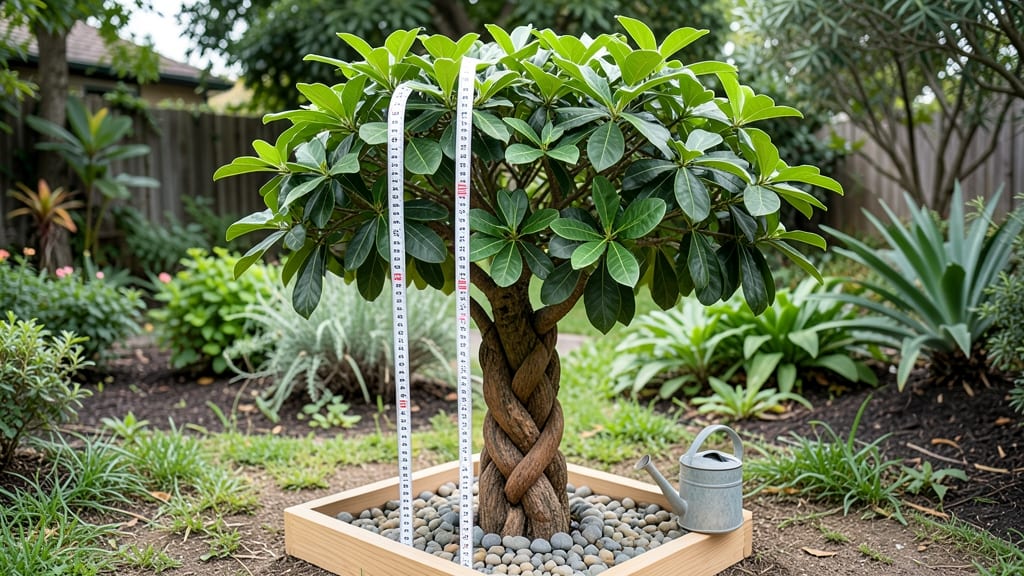
A money tree indoors can grow anywhere from 3 to 10 feet tall, depending on how you care for it and the variety you choose.
If you’ve ever watched your 🌿 Pachira aquatica stretch toward the ceiling or lean precariously to one side, you’re not alone. This tropical favorite doesn’t stay small—unless you take steps to control its growth.
The good news? With the right pruning and pot size, you can keep it at a manageable height without sacrificing its lush, braided charm.
Light plays a huge role in how tall your money tree grows. Too little light slows it down, while too much can make it leggy and top-heavy. But it’s not just about sunlight—pot size, pruning habits, and even your home’s humidity levels can shift its growth trajectory.
Let’s break down what influences its height and how to keep it at your ideal size.
In this guide, you’ll discover the typical height ranges for standard and dwarf varieties, proven pruning techniques to control its size, and the best indoor conditions to keep it thriving—without it becoming a ceiling hazard. Ready to master your money tree’s growth?


Indoor money tree growth limits: how tall can it really get?
The money tree (Pachira aquatica) is a popular indoor plant known for its lush green leaves and symbolic good fortune. But how tall can it actually grow indoors? Without proper care, your money tree could reach 6 to 10 feet—taller than most ceilings!
The good news? With the right techniques, you can easily manage its height to fit your space. Let’s explore the factors that influence its growth and how to estimate its mature size.
Your money tree’s height depends on three key factors: genetics, light exposure, and pot size. Dwarf varieties may stay around 3 to 5 feet, while standard types can stretch toward 10 feet if left unchecked.
Even with ideal conditions, growth slows after the first few years, so don’t panic if it doesn’t shoot up overnight. Understanding these limits helps you plan for pruning and repotting early.
Light is the biggest growth accelerator. A money tree thrives in bright indirect light, which encourages rapid growth—up to 12 inches per year in ideal conditions. Place it near an east or north-facing window to avoid leggy stems. If your tree gets low light, expect slower growth (3–6 inches per year) and weaker stems. This makes light the easiest factor to control for height management.
Pot size directly impacts root development and, consequently, height. A money tree in a small pot (6–8 inches) will grow slower because its roots are restricted. Upgrading to a 12-inch pot can double its growth rate in a year. However, oversized pots lead to overwatering risks, so match the pot to your tree’s current size. For example, a 3-foot-tall tree thrives in an 8-inch pot, while a 6-foot tree needs at least a 12-inch pot.
Genetics play a surprising role in your money tree’s height. Some varieties, like the braided money tree, are bred for compact growth and rarely exceed 5 feet. Others, such as the standard money tree, can reach 10 feet if given the right conditions.
Even within the same species, individual trees vary. For example, a tree from a nursery might grow 20% taller than one propagated from a cutting due to genetic differences. If you’re buying a money tree, ask about its parent plant’s size to get a better estimate.
Estimating your money tree’s mature height is easier once you account for its age. In the first year, expect 1–2 feet of growth. By year two, it may double to 3–5 feet. After three years, growth slows, and a standard variety typically tops out at 6–10 feet.
To predict its final height, observe its growth rate in the first year. If it grows 12 inches, it’s likely a fast grower and may reach 8–10 feet. Slower growth (6 inches/year) suggests a dwarf variety or limited conditions.
One common misconception is that money trees grow like bonsai trees—small and controlled by default. In reality, bonsai techniques are required to keep a money tree tiny. Without regular pruning, staking, and root restriction, even dwarf varieties will grow to their full height.
If you want a miniature money tree, treat it like a bonsai: prune aggressively, use small pots, and limit fertilizer. Otherwise, expect it to grow to its natural size.
To keep your money tree at a manageable height, focus on pruning and light control. Prune in early spring by cutting back 1/3 of the new growth to encourage bushiness. Avoid heavy pruning in fall or winter, as this stresses the plant.
For dramatic height reduction, prune just above a leaf node in late winter. This method can reduce height by up to 50% in a single season. Pair pruning with proper light exposure to maintain a balanced, compact shape.
If your money tree is already too tall for its space, don’t worry—you can still manage it. Start by moving it to a shadier spot to slow growth. Combine this with root pruning during repotting to restrict upward growth.
For immediate height reduction, prune the top 1–2 feet of the stem. New shoots will sprout below the cut, creating a fuller, shorter tree. With patience and consistent care, you can transform an overgrown money tree into a manageable centerpiece.
Remember, the key to controlling your money tree’s height lies in proactive care. Monitor its growth rate, adjust light exposure, and prune regularly.
With these strategies, you can enjoy a thriving money tree that fits perfectly in your home—whether you prefer a compact 3-foot bush or a tall 8-foot statement piece. The choice is yours, and the results will be well worth the effort! 🌿
5 Proven techniques to control money tree height indoors
Controlling your money tree's height indoors starts with understanding its natural growth patterns. Without intervention, these tropical plants can reach 6–10 feet indoors—often faster than expected! The good news? With the right techniques, you can keep it compact, encourage bushier growth, or maintain a desired height for your space.
Let’s explore five practical methods to manage its size effectively.
First, pruning is the most direct way to control height. Unlike many plants, money trees respond well to pruning, even if you’re new to the practice. The key is timing—prune just above a leaf node (where leaves grow) to encourage branching.
This not only reduces height but also creates a fuller, more attractive shape. I’ve found that pruning in spring or early summer yields the best results for bushier growth.
Trim 1/3 of top growth in March or April to encourage branching. Use sterilized scissors and seal cuts with cinnamon powder to prevent disease.
Use a smaller pot (1–2 inches wider) to limit root growth. Money trees grow toward light and space, so a tighter pot naturally slows height increase.
Reduce nitrogen-rich fertilizer to curb rapid vertical growth. Switch to a balanced 10-10-10 in smaller doses (half the recommended amount) to promote width over height.
Turn the pot quarter-turn weekly so all sides get equal light. This prevents lopsided growth and encourages a balanced shape rather than stretching upward.
Use a stake or bamboo pole to stabilize tall stems. Secure with soft plant ties to prevent toppling, especially in drafty areas or after pruning.
Another often-overlooked technique is pot selection. Money trees grow toward light, so a larger pot encourages taller growth as the roots spread. I recommend using a pot that’s only 1–2 inches wider than the root ball to slow vertical growth.
Additionally, choose pots with a narrower base—this naturally limits root expansion and, in turn, height. For example, a 6-inch pot will keep your money tree more compact than a 12-inch pot.
Seasonal adjustments also play a crucial role. During winter months, reduce watering and avoid fertilizing entirely. This dormancy period helps control rapid growth spurts that often occur in spring.
I’ve noticed that money trees I’ve cared for with winter rest grow more evenly and stay shorter than those fertilized year-round. Pair this with bright indirect light (like an east-facing window) to maintain a healthy, manageable size.
Finally, don’t forget about propagation as a bonus technique! If your money tree gets too tall, you can prune the top and propagate the cuttings in water. This gives you a new plant while keeping your original money tree at your desired height.
It’s a win-win for both size control and expanding your plant collection! Just be patient—rooting can take 4–6 weeks.
With these five techniques, you’ll have full control over your money tree’s height. Whether you want it as a tabletop centerpiece or a tall statement plant, the key is consistency in pruning, pot size, and seasonal care. Happy growing! ✂️🌿