
Blooming
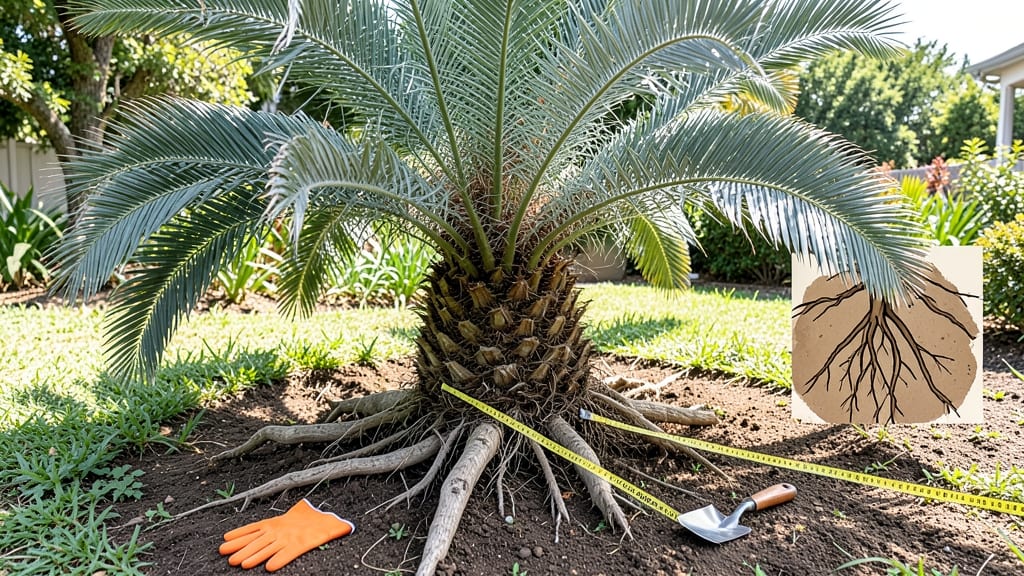
Palm tree roots extend horizontally 3 to 5 times the tree's height but rarely penetrate deeper than 2 to 3 feet, creating a shallow but expansive network that prioritizes stability over depth. This fibrous system thrives in loose, well-aerated soil to prevent waterlogging and structural compromise.
Understanding this growth pattern helps explain why palm trees often lean or topple in compacted soil—roots spread outward for balance but lack the depth to anchor against wind. 🌴 For example, a 30-foot-tall coconut palm might have roots stretching 90 feet outward while barely reaching 2 feet down, which is why proper spacing and drainage become critical during planting.
The trade-off between horizontal reach and limited depth also affects transplanting: disturbing the root system can take years to recover fully.
This shallow root structure isn't a flaw—it's an adaptation. Palm trees native to tropical regions evolved to maximize surface area for water and nutrient absorption in nutrient-poor soils, often with sandy or rocky substrates.
The key takeaway? When planting palms, focus on horizontal space (at least 10 feet from structures) and soil preparation (amending clay or compacted soil with organic matter) to replicate their natural growing conditions.
💡 In This Article
- Palm Tree Root Systems: Horizontal Spread vs Depth
- Planting Palm Trees: Soil and Space Requirements
Palm tree root systems: horizontal spread vs depth
Palm trees have evolved a unique root architecture where fibrous roots dominate the upper 6-12 inches of soil, spreading horizontally in a wide, shallow network. This design prioritizes stability over depth because palm trunks lack the rigid wood found in trees like oaks.
Instead, they rely on a dense mat of roots—often 30-50% of the tree's height in diameter—to resist wind and storms. For instance, a 20-foot-tall royal palm may have roots spreading 60 feet outward while its deepest roots rarely exceed 2 feet.
The shallow depth isn't accidental—it's an adaptation to tropical environments where heavy rainfall and nutrient-poor soils demand rapid water absorption. Unlike taproots (found in trees like maples), palm roots grow in clusters from the stem's base, creating a self-supporting structure.
However, this makes them vulnerable to soil compaction, which restricts oxygen flow and triggers root rot. In natural habitats, loose, sandy soils allow roots to expand freely, while compacted urban soils force them to grow in unnatural patterns, often causing the tree to lean or topple. 🌴
Comparing species reveals fascinating variations: coconut palms develop pneumatophores (aerial roots) for oxygen in waterlogged areas, while date palms have thicker lateral roots to store water in arid climates.
The Mexican fan palm, however, has roots that spread up to 6 times its height—the most extreme horizontal growth in the family. This diversity explains why some palms thrive in coastal winds while others struggle in inland areas with heavier soils.
Soil chemistry plays a crucial role too. Palm roots secrete enzymes to break down organic matter, but they struggle in alkaline soils (pH >7.5), where nutrient uptake slows.
The fibrous network also means roots compete fiercely for space—planting palms too close (less than 10 feet apart) leads to stunted growth as roots tangle. This competition is why mature palms often develop buttress-like root flares at the base, acting as natural shock absorbers against wind.
What most gardeners overlook is how root growth responds to seasonal changes. In wet seasons, roots expand rapidly to absorb excess water, while in droughts, they contract slightly to conserve moisture.
This dynamic system explains why newly planted palms need consistent moisture for the first 2 years—their shallow roots can't reach deep water sources. 💧 The trade-off between horizontal reach and limited depth is what makes palm trees both resilient and delicate in the right conditions.
Understanding this balance helps explain why palm trees often fail in poor soil: their roots can't compensate for poor drainage or nutrient deficiencies like deeper-rooted species.
For example, a 30-foot sabal palm in clay soil may develop roots only 1 foot deep but spread 90 feet wide, creating a precarious anchor. This is why amending soil with organic matter before planting is critical—it mimics the loose, aerated conditions palms evolved to thrive in.