
Plants
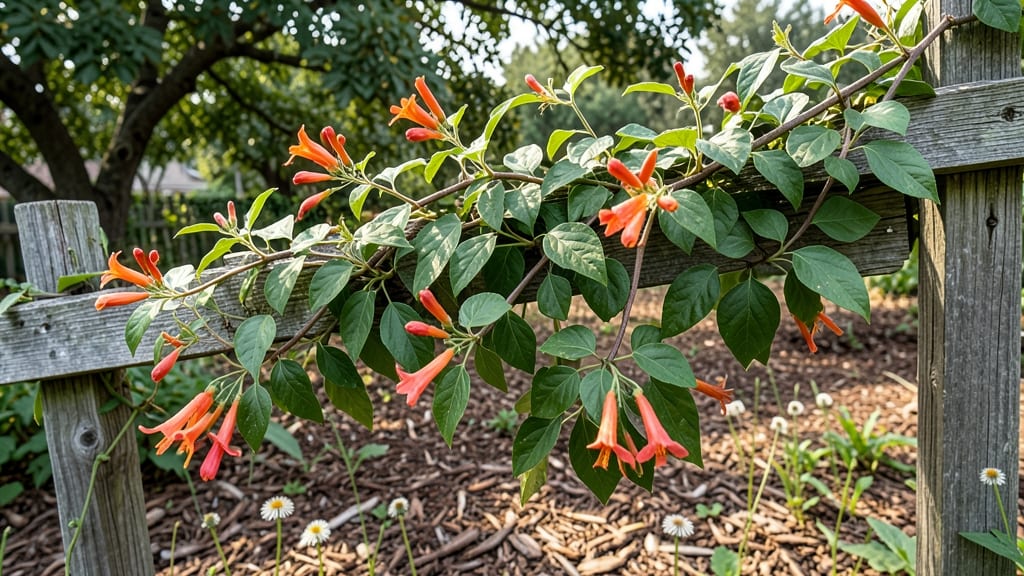
A honeysuckle tree looks like a lush, fragrant shrub with shiny oval leaves that have jagged edges and delicate tubular flowers growing in small clusters of 1-3. The flowers typically bloom in soft yellow or creamy hues, while the tree's trunk has smooth grayish-brown bark and elegant, arching branches.
A honeysuckle tree stands out in any garden with its distinctive foliage and sweet-smelling blooms. 🌿 The leaves, which are typically 2-6 inches long, have a rich green color that adds vibrant texture to landscapes.
These evergreen or semi-evergreen plants thrive in various climates, making them popular for hedges or privacy screens. The tubular flowers aren't just pretty—they're a magnet for hummingbirds and butterflies, adding life to your outdoor space.
What many don't realize is how versatile these trees are in different settings. Japanese honeysuckle, for example, grows as a vine, while Chinese honeysuckle often forms a small tree or large shrub.
Their adaptability means they can work in everything from formal gardens to wild landscapes. The key to identifying them is noticing those fragrant clusters of flowers and the tree's overall graceful form.
💡 In This Article
- Identifying Honeysuckle Tree Leaves and Flowers
- Honeysuckle Tree Growth Habits and Landscape Uses
Identifying honeysuckle tree leaves and flowers
The honeysuckle tree's leaves are one of its most distinctive features, with a leathery texture and elliptical shape that tapers to a point. Each leaf measures between 2-6 inches long and 1-2.5 inches wide, with serrated edges that create a saw-like appearance when viewed closely.
The upper surface boasts a deep, glossy green hue, while the underside often appears slightly lighter, creating a two-toned effect that's easy to spot in natural light.
What makes these leaves truly unique is their arrangement—alternate along the stems with a slight twist at each node, creating a spiral pattern when viewed from above. This phyllotactic spiral isn't just visually striking but also helps distinguish honeysuckle from similar trees like lilac or forsythia.
The leaves emit a faint, sweet fragrance when crushed, though nothing compares to the intense floral scent of the tree's blooms, which can be detected from 20-30 feet away on warm summer evenings.
The flowers are the real showstoppers, growing in terminal clusters of 1-3 at the tips of branches. Each tubular bloom measures about 1-1.5 inches long and opens to reveal a bright yellow or creamy-white throat surrounded by five slightly reflexed petals.
The color variations are subtle but significant—Japanese honeysuckle (Lonicera japonica) typically produces pale yellow flowers, while Chinese honeysuckle (Lonicera chinensis) often features creamy-white blooms with yellow centers. These flowers aren't just beautiful; they're highly fragrant, with a sweet, honey-like aroma that peaks in the late afternoon.
The blooming season varies by species but generally occurs between late spring and early summer, with some varieties producing a second flush of flowers in late summer or early fall. This extended blooming period makes honeysuckle trees particularly valuable for pollinators.
The tubular shape of the flowers is perfectly adapted to attract hummingbirds and long-tongued bees, while the nectar provides essential energy for migrating birds. 🌸 The flowers' structure also creates a natural "landing platform" that makes them easily accessible for these visitors.
One fascinating botanical detail is how the flowers develop: they start as buds wrapped in two bracts (modified leaves) that protect the delicate blossoms as they form. As the flower opens, these bracts remain attached below the bloom, creating a distinctive two-lipped appearance that's another key identification feature.
This structure also helps channel nectar to the base of the flower, ensuring pollinators get rewarded for their visits.
When comparing honeysuckle to similar trees, pay attention to these key differences:
- Leaf arrangement: Honeysuckle's alternate, spiral pattern vs. lilac's opposite pairs
- Flower clusters: Honeysuckle's 1-3 flowers per cluster vs. lilac's dense panicles
- Scent: Honeysuckle's sweet, honey-like fragrance vs. lilac's powdery, floral aroma
- Bark texture: Honeysuckle's smooth, grayish-brown vs. forsythia's exfoliating orange-brown