
Plants
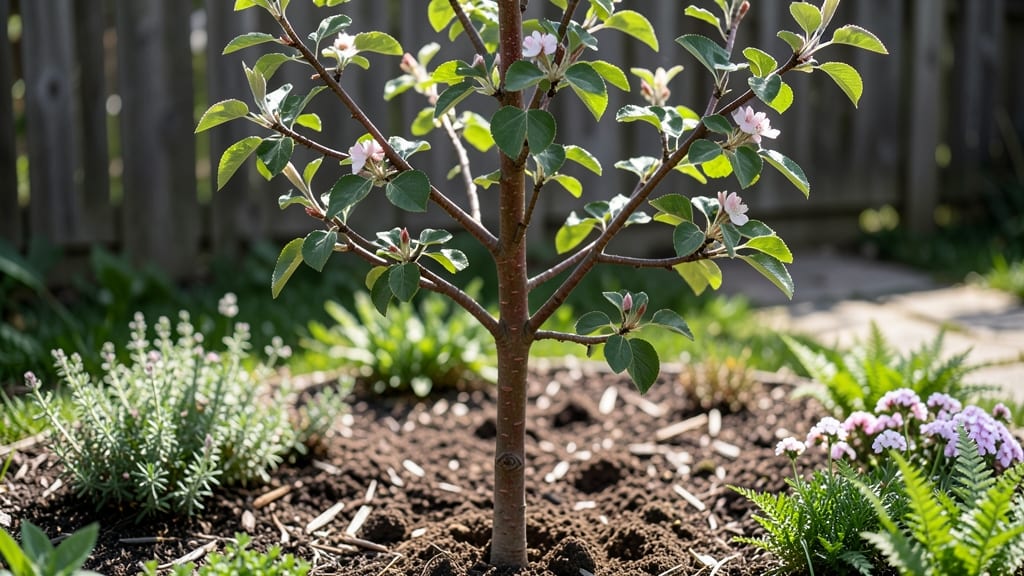
A young apple tree looks like a slender sapling with smooth, grayish-brown bark and small, light green leaves that have jagged edges. Its upright branches form a vase shape until it matures into a fuller canopy.
A young apple tree's most distinctive feature is its delicate foliage—leaves are typically 1-3 inches long with fine serrations along the edges, resembling miniature versions of mature apple leaves. 🌿 The bark remains smooth and slightly peeling in strips, unlike the rough, ridged bark of older trees.
In their first few years, these trees grow vertically at a rapid pace, often reaching 3-6 feet annually, with a narrow, upright growth habit that makes them easy to spot in orchards or gardens.
What sets young apple trees apart from other fruit trees is their leaf arrangement—alternate branching with leaves growing in a spiral pattern along the stems. During spring, the new growth appears bright green and slightly fuzzy, while summer foliage darkens to a deeper green.
This early growth stage is also when you'll notice the first tiny blossoms forming, though fruit production won't begin for several years.
💡 In This Article
- Identifying Young Apple Tree Bark and Leaf Characteristics
- Growth Habits of Saplings: Height, Spread, and Root Development
Identifying young apple tree bark and leaf characteristics
The bark of a young apple tree is one of its most reliable identification markers.
Unlike mature trees that develop rough, deeply furrowed bark, saplings have a smooth, grayish-brown surface that often peels in thin strips as they grow. 🌳 This peeling occurs because the bark grows faster than the tree's diameter, creating a layered effect.
The texture is almost like sun-warmed granite—cool to the touch and slightly rough to the fingertips, but far smoother than the ridged bark of an older apple tree.
When examining the leaves, size and shape are key distinguishing features. Young apple tree leaves typically measure between 1-3 inches long and 1-2 inches wide, with a distinctive oval shape that tapers to a pointed tip.
The edges have fine, saw-like serrations (about 10-15 teeth per inch) that create a scalloped appearance when viewed from above.
In spring, these leaves emerge bright green with a slight fuzzy texture due to fine hairs on the undersides, which disappear as they mature to a deeper, glossy green by summer.
The branching pattern of young apple trees follows a predictable growth habit that sets them apart from other fruit trees. Saplings grow in a vase-like shape, with the main trunk giving rise to several strong, upright branches that spread at 45-60 degree angles.
This differs from mature apple trees, which develop a more rounded, horizontal canopy. 🌿 The leaf arrangement is also distinctive—leaves grow alternately along the stems in a spiral pattern, rather than opposite each other like in pear trees or in clusters like in cherry trees.
Seasonal changes offer additional clues for identification. In early spring, you'll notice clusters of pink or white blossoms emerging from the branches, though these won't develop into fruit for several years.
The foliage also changes color seasonally: new growth appears bright lime green in spring, darkens to a rich green in summer, and may develop yellow or orange hues in fall before dropping. This color progression helps distinguish young apple trees from other deciduous trees that maintain consistent green foliage year-round.
One common point of confusion is distinguishing young apple trees from crabapple trees, which share similar leaf shapes. The key difference lies in the leaf size and serration pattern—crabapple leaves are typically smaller (1/2-1 inch long) with more pronounced serrations (20+ teeth per inch).
Additionally, crabapple trees often have a more open, irregular branching pattern rather than the structured vase shape of young apple trees.
For those attempting to identify young apple trees in the wild, pay attention to these three key characteristics: the smooth, peeling bark; the medium-sized leaves with moderate serrations; and the upright, vase-shaped branching.
These features combined create a profile that's distinctly different from both mature apple trees and other fruit tree varieties.